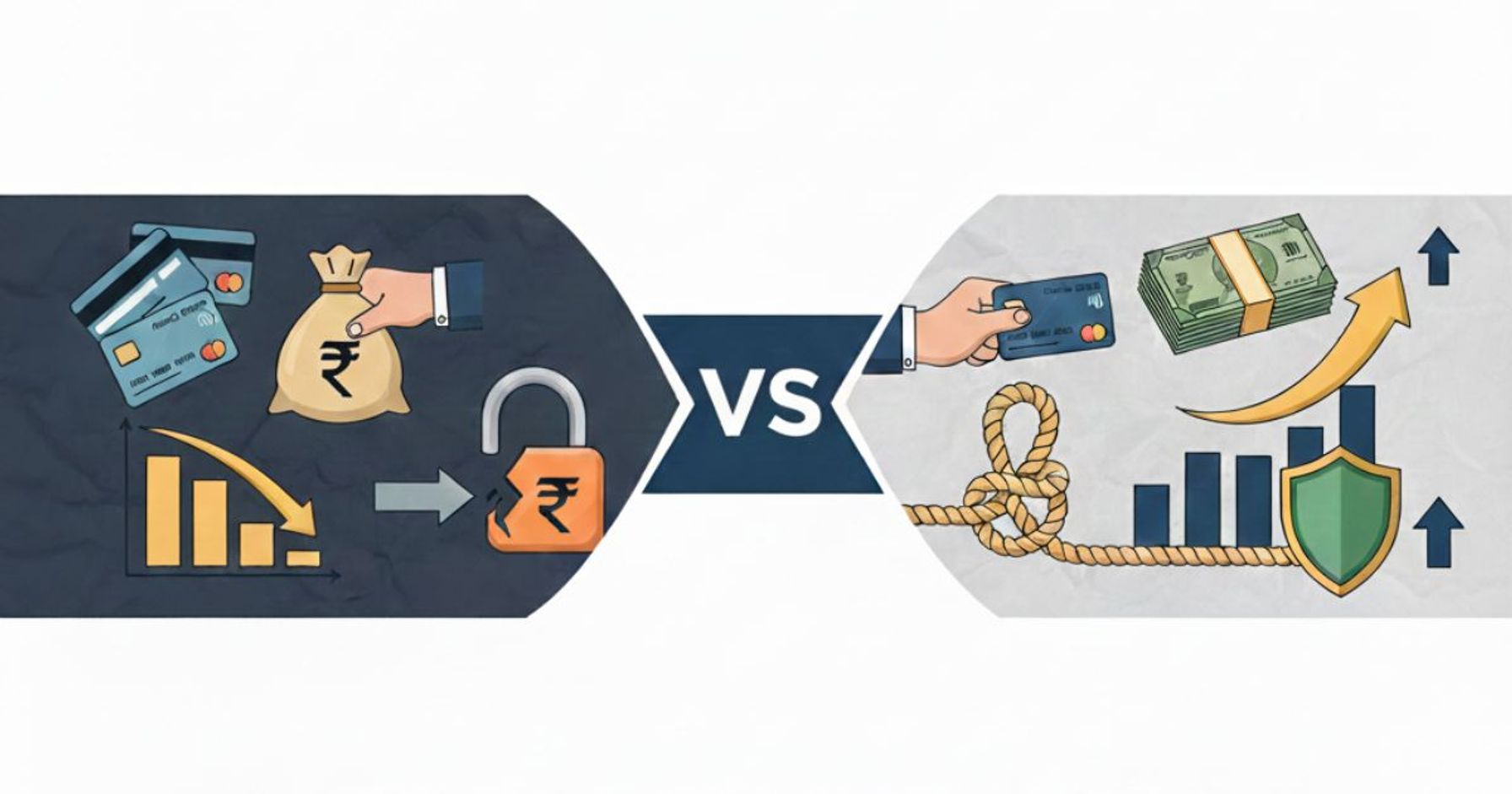
Managing credit card debt can feel overwhelming, especially when bills start piling up, and recovery calls become frequent. Many people in India between the ages of 30–50 face this challenge at some point in their lives due to job changes, medical emergencies, business instability, or unexpected expenses. When the pressure becomes difficult to handle, two common options people explore are:
- Credit Card Debt Settlement
- Debt Consolidation
Both approaches aim to reduce financial stress, but they work very differently. This blog explains each option in a simple, human, and practical way, helping you understand which one may suit your situation better.
What Is Credit Card Debt Settlement?
Credit card debt settlement is a negotiation-based process where the borrower and the lender try to come to a mutually acceptable closure for the outstanding amount. Borrowers usually consider settlement when repayment becomes genuinely difficult.
Why do people choose settlement:
- To reduce financial stress
- When income suddenly drops
- When dues become too high
- When recovery pressure increases
- When repayment is no longer manageable
Settlement focuses on bringing relief by closing the account through communication, negotiation, and a structured process.
What settlement is NOT:
- It is not a guarantee
- It is not an overnight solution
- It is not a way to avoid responsibility
- It does not eliminate the borrowing history
It is simply a practical option for people going through genuine financial hardship.
What Is Debt Consolidation?
Debt consolidation means combining multiple debts into one, so that the borrower deals with only a single payment instead of multiple dues.
This typically involves transferring debt to:
- A loan product with a different repayment structure
- Another bank account
- A different credit facility that allows simplified monthly payments
People choose consolidation when they want better control, easier tracking, or less confusion around multiple credit card bills.
Why do people choose consolidation?
- It simplifies monthly payments
- It becomes easier to manage finances
- It reduces the stress of multiple deadlines
- It creates a more organised repayment approach
Consolidation is not about negotiation; it is more about restructuring how payments are handled.
Key Differences Between Debt Settlement and Debt Consolidation
Understanding the difference can help you see which option may align better with your current situation.
1. Purpose
Debt Settlement: Helps borrowers facing difficulty in repayment and looking for a practical closure.
Debt Consolidation: Helps borrowers who can still repay but want a more manageable, organised repayment structure.
2. Approach
Debt Settlement: Negotiation-driven, usually for people dealing with financial strain.
Debt Consolidation: Repayment-driven, allowing borrowers to handle credit card dues in a simplified manner.
3. When People Choose These Options
Debt Settlement: When income becomes unstable, repayment feels impossible, or recovery pressure increases.
Debt Consolidation: When someone wants better control over payments without changing the total dues significantly.
4. Stress Handling
Debt Settlement: Helps reduce emotional and financial pressure by aiming for closure.
Debt Consolidation: Helps reduce operational stress (multiple bills, reminders, due dates).
Which Option Should You Choose?
Choosing between settlement and consolidation depends on your actual financial condition, not on what sounds easier.
You may consider credit card debt settlement if:
- You are unable to repay
- Dues have become unmanageable
- Your income has reduced
- You are facing recovery agent pressure
- You want to close the dispute with clarity
You may consider debt consolidation if:
- You can still repay
- You want a simpler monthly structure
- You want to avoid juggling multiple payments
- You prefer stability over negotiation
There is no “better” option; it is about what aligns with your reality.
Why Many Borrowers Explore Settlement or Resolution Services
When borrowers feel stuck, confused, or stressed, they sometimes reach out to a loan or credit card resolution service for help.
Such services usually assist with:
- Understanding your current financial situation
- Communicating with lenders
- Guiding on negotiation
- Reducing emotional stress
- Helping manage recovery agent pressure
- Exploring available resolution paths
This support can make the process easier, especially when you don’t know what to do next.
Common Myths About Settlement & Consolidation
Myth 1: “Both options are the same.” No, they serve completely different purposes.
Myth 2: “Settlement solves everything instantly.” It is a process, not an overnight fix.
Myth 3: “Consolidation means lower dues.” Consolidation is mainly about simplifying payment, not reducing the total.
Myth 4: “Only people with huge debts need help.” Any borrower feeling stressed may explore these options.
Conclusion
Credit card debt can create a lot of pressure, emotionally, mentally, and financially. Understanding the difference between debt settlement and debt consolidation helps you make a more informed, balanced decision.
If repayment is impossible → Settlement may be explored If repayment is possible but complicated → Consolidation may help
The goal is not to choose the “easier” option but the one that aligns with your real situation. Whether you’re facing recovery pressure or just want better control over payments, knowing your options is the first step toward financial clarity.